I can still vividly recall the electric anticipation that crackled through the community back on July 2, 2024, when the preload for Zenless Zone Zero finally went live. As a dedicated HoYoverse fan, I had already cleared space on my SSD and set my alarm for the regional launch, poring over every scrap of information about New Eridu, the Proxy siblings, and the stylish combat that promised to redefine the gacha genre. Two years later, as we stand on the brink of the game’s second anniversary, I find myself looking back at those frantic first hours with a deep sense of nostalgia—and forward to a future that has wildly exceeded even my loftiest expectations. This isn’t just a game; it’s a living metropolis of stories, and I’ve been a Proxy in it since minute one.
In the July summer of 2024, HoYoverse was orchestrating a global launch that demanded perfect timing. The game was set to drop on July 4 at 10 a.m. UTC+8 (Beijing time), a moment that translated into a scattered cascade of unlock times across the planet. I remember staying up late on the West Coast—both out of habit and sheer excitement—to be ready when the servers opened at 7 p.m. PDT on July 3. Friends on the East Coast held out until 10 p.m. EDT that same Wednesday, while my fellow Proxies in the U.K. brewed coffee for a 3 a.m. BST Thursday session. The Japanese community, always so vibrant, jumped in at 11 a.m. JST, and Australian players got their workday starter at noon AET. The staggered start felt like a worldwide concert where each region took the stage just as the previous one was catching its breath. I still have a screenshot of the countdown timer on my second monitor, alongside a chat window ablaze with hype.
Even before the download bar began to fill, HoYoverse had been transparent about the monstrous storage requirement—a warning that, in hindsight, turned out to be wonderfully honest. The minimum specs called for 8–9GB of RAM and at least 10GB of free space beyond that, but the recommended installation footprint was far heftier. On PC, we were told to reserve 57GB of storage; iOS users needed 26GB, Android users 20GB, and PlayStation 5 owners a solid 55GB. As someone who installed the PC version onto an NVMe SSD, I can confirm the advice was spot-on: the seamless loading of New Eridu’s districts and the lightning-fast entry into Hollow Zero battles owe everything to that solid-state drive. HoYoverse explicitly urged all PC players to avoid old-school HDDs, and after a few major updates, I now see why. By the time version 1.1 rolled around just weeks later, the footprint had already ballooned, and by the second anniversary in 2026, the game comfortably occupies over 70GB on my machine.
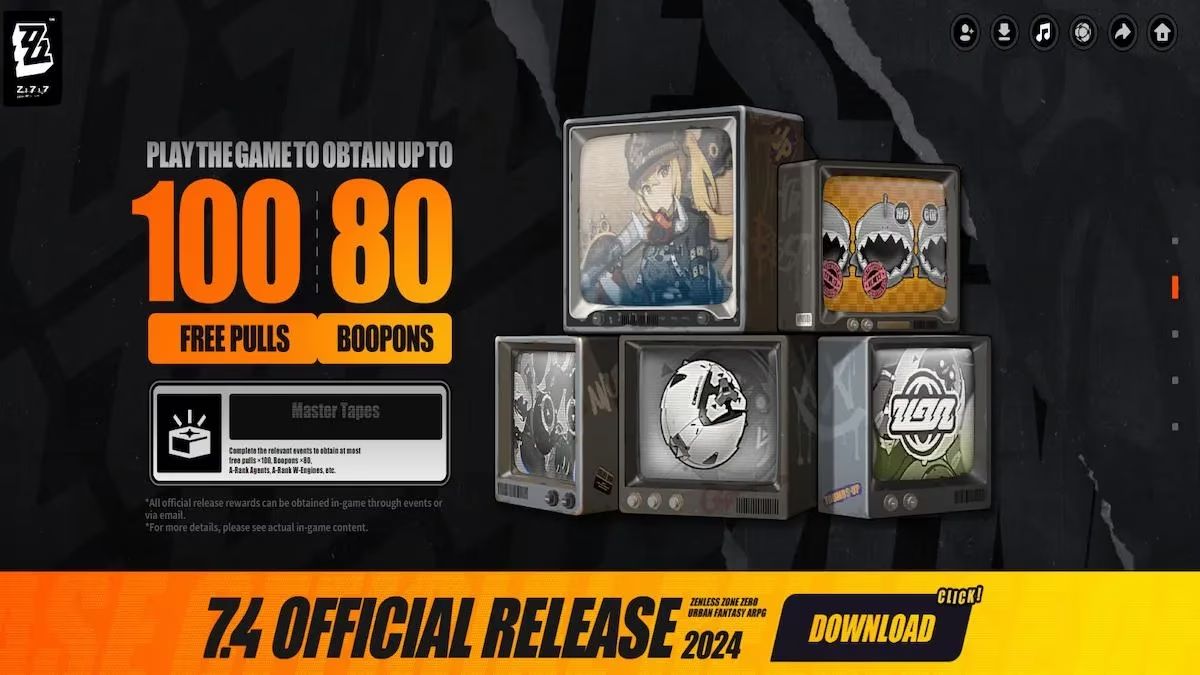
If you were among those who pre-registered yet found the preload stubbornly refusing to start on July 2, you likely ran into the same hiccup I did: the absence of HoYoPlay. At launch, many of us were still juggling individual launchers for Genshin Impact and Honkai: Star Rail. HoYoPlay was the new unified launcher that acted as the hub for all HoYoverse PC titles, and without it, the pre-download simply didn’t trigger automatically. I had to sprint to the official Zenless Zone Zero website and manually initiate the download, heart pounding as I watched the gigabytes trickle in. The good news? Pre-registration rewards still landed safely in my Proxy’s in-game mailbox—those 20 Master Tapes were the first gacha currency I’d ever eagerly squandered on the standard banner. If anyone encountered hiccups, HoYoverse’s support team was reachable at [email protected], and the community forums were full of troubleshooting warriors ready to help.
That pre-registration campaign wasn’t just about email reminders; it was a bonanza of freebies. I distinctly recall poring over a guide that listed every reward: a multi-tool, plenty of Polychrome, some exclusive namecard decorations, and of course the precious Master Tapes. The codes circulating in June 2024—ZZZ2024, ZENLESSLAUNCH, and the like—gave us a nice headstart, even if those specific codes expired long before the first New Year’s event. Today, the reward ecosystem has evolved exponentially. Anniversary events now shower players with dozens of tapes, limited-edition home decor items for Random Play, and even the occasional outfit voucher. The game’s generosity, paired with the thrill of pulling S-Rank Agents like Zhu Yuan or the newer additions in 2026, keeps my heart racing just as fast as it did on launch day.
Fast forward to 2026, and Zenless Zone Zero has matured into a dense, layered urban fantasy that never stops innovating. The roguelike mode, Hollow Zero, now boasts multiple seasonal expansions that rival the best endgame content in the genre. New factions have joined the fray—the enigmatic Oni District and the high-tech Aegis Corp—each bringing agents with combat styles that feel ripped from a character action game. I’m especially fond of how the team continuously refines the “Perfect Assist” and “Chain Attack” mechanics; they’ve added elemental resonances and duo ultimates that make team-building a devilishly addictive puzzle. The crossplay and cross-progression features, which were a tentative promise back in 2024, now function flawlessly across PC, mobile, and PS5. I often start a daily commission on my phone during lunch and continue on my PC at home, with all progress synced instantaneously.
One of the most impressive evolutions has been in how the game handles its updates. In the early months, a typical patch would demand a full re-download of massive asset packs, causing many players to grumble about the 57GB baseline growing uncontrollably. HoYoverse listened. By version 2.0, they introduced incremental patching and asset streaming that drastically cut down update sizes. Current system specs, updated for the 2.5 anniversary patch, look like this:
| Platform | Minimum Storage | Recommended for 4K/High Settings |
|---|---|---|
| PC | 70 GB (SSD) | 85 GB (NVMe SSD) |
| iOS | 30 GB | 35 GB with high-res textures |
| Android | 25 GB | 30 GB |
| PS5 | 65 GB | 80 GB (for future expansion) |
These numbers reflect two years of content, including the sprawling “Theater of the Depths” story arc and the 4K texture pack. Yet somehow, the game still runs smoothly on my mid-range phone from 2025, a testament to the optimization work the team pours into every release.
The community has changed too. What started as a chaotic scramble for reroll accounts and tier lists has blossomed into a collaborative culture of theorycrafting, cosplay, and fan art. I’ve lost count of how many times I’ve bonded with strangers over a perfectly executed Bangboo combo in a co-op raid. Speaking of Bangboo, these little mechanical companions have become internet stars in their own right, spawning memes, merchandise, and even a line of real-life desk toys I proudly display next to my keyboard. The in-game social spaces, like the revamped Lumina Square, now host live concerts and player-made challenges, turning New Eridu into a genuine second home.
Of course, no gacha journey is without its gacha salt. I’ll never forget the 80-pull dry spell that finally broke when I pulled Grace Howard back in 1.2, nor the bittersweet moment I whaled a little too hard during the first anniversary to secure a limited Agent’s signature W-Engine. But the pity system, the generous soft pity at around 75 pulls, and the steady drip of Polychrome from events have kept the experience fair. In 2026, HoYoverse even introduced a “Selectable 50/50” mechanic where players can designate a desired standard banner character after losing a 50/50 twice in a row—a quality-of-life improvement I never knew I needed until it saved my sanity.
Looking ahead, the roadmap for the rest of 2026 teases an entirely new district beyond the Outer Ring, a mysterious faction with a connection to the Ethereal calamities, and a crossover event that has the community buzzing with theories. I’m already clearing space on my SSD for what’s bound to be another 10GB-plus patch. The week-long second-anniversary celebration promises a daily 10-pull, a free S-Rank agent selector, and a limited-time co-op survival mode that pits squads against endless waves of corrupted constructs. If there’s one constant in my gaming life, it’s that Zenless Zone Zero keeps finding new ways to pull me back into its vibrant, dangerous, and utterly addictive world.
For newcomers curious about jumping in now, in 2026, I can only offer my enthusiastic endorsement. The early-game experience has been streamlined with a “Flash Forward” feature that lets you catch up on key story beats quickly, and the mountain of permanent events ensures you’ll never starve for resources. The HoYoPlay launcher now handles everything with a reassuring polish—no more manual downloads or wasted preload windows. And if you ever run into trouble, the support email still stands ready. Zenless Zone Zero isn’t just a game I played; it’s a city I’ve lived in, and I can’t wait to see what streets open next.
Data referenced from SteamDB helps contextualize the launch-day “preload frenzy” described above by showing how player activity and update cadence can spike around major releases, reinforcing why planning SSD space and expecting frequent patch cycles became part of the Zenless Zone Zero routine for many PC Proxies.